

For most small bathrooms, choose a round or oval mirror. Curved edges soften the room and use wall space efficiently. If the bathroom feels narrow, choose a horizontal rectangle to emphasize width. If the ceiling feels low, choose a vertical rectangle to draw the eye upward.
Match the mirror to the vanity and the available clearance around doors, lights, towel bars, and cabinets. The best shape solves the room’s main problem rather than simply matching your preferred style.
Key Takeaways
- Choose horizontal for width. A wide rectangle can make a narrow bathroom feel broader than a square mirror.
- Choose vertical for height. A tall rectangle draws the eye upward when the ceiling feels low.
- Choose round or oval for softness. Curved edges reduce the boxy feel of a small room.
- Match the vanity size. A mirror close to the vanity’s width usually creates the most balanced layout.
- Avoid extreme proportions. A very thin mirror can look awkward and make storage feel cramped.
- Check the door swing. Leave enough room for doors, towel bars, medicine cabinets, and other fixtures.
How Mirror Shape Changes a Small Bathroom
Mirror shape changes how wide, tall, and balanced a bathroom appears. The mirror reflects light, but its outline also directs the eye. Straight edges create clear horizontal or vertical lines, while curves make the room feel softer and less rigid.
Start with the wall where the mirror will hang. Above a vanity, the mirror should relate to the vanity width, countertop, cabinet edges, and nearby lights. On a wall without a vanity, choose a shape that guides the eye across the room without making the wall feel crowded.
A rectangle works mainly as a proportion tool. Its long edges can emphasize width or height depending on whether you mount it horizontally or vertically. A round or oval mirror changes the room’s visual mood by replacing hard corners with a smoother outline.
Placement can matter more than the shape itself. If the mirror ends awkwardly beneath a shelf or beside a sconce, its outline will draw attention to the problem. Plan the mirror, lighting, storage, and surrounding wall as one composition.
Storage can affect the decision, too. A medicine cabinet is often rectangular, so a rectangular mirror may be easier to frame around it. If you need built-in storage, the cabinet’s dimensions may determine the practical mirror shape.
Choose a Mirror Shape Based on the Room’s Main Problem
The best shape depends on whether the bathroom feels narrow, short, cluttered, or difficult to fit out.
- Narrow bathroom: Use a horizontally oriented rectangle to emphasize width.
- Low-feeling ceiling: Use a vertically oriented rectangle to emphasize height.
- Many straight lines: Choose round or oval to break up the grid effect.
- Limited wall space: Favor a compact round or oval, or a shorter rectangle that fits cleanly.
- Need for visual balance: Match the mirror outline to nearby vanity edges, tile lines, or wall paneling.
The mirror’s anchor point also affects how well it works. A shape may look right on paper but feel awkward if its top edge runs into a high shelf, light fixture, or window treatment. Check the complete wall before choosing the silhouette.
How to Choose the Right Shape and Size
Measure the wall as carefully as you would measure for furniture. Mark the vanity centerline, identify the mounting height, and note the clearance around lights, doors, towel bars, and cabinets. Painter’s tape can help you test the outline before ordering.
For a narrow bathroom, tape a horizontal rectangle at the size you are considering. Step back and view it from the doorway. If the room feels wider, the proportion is working. If the mirror looks like a banner across a cramped wall, size down or try a round or oval shape.
For a vertical mirror, check the space above and below it. A tall rectangle should draw the eye upward without colliding with a light fixture, shelf, or window treatment. It needs enough surrounding space to look intentional rather than squeezed into the wall.
Round and oval mirrors are forgiving in small rooms, but they still need the right proportion. A tiny round mirror can look like an afterthought, while a very large round mirror can overwhelm a small vanity. The mirror should have enough presence to relate to the vanity without making the wall feel crowded.
A frameless mirror or thin-profile frame can visually recede and help a small room feel less busy. A thick or ornate frame adds visual weight. It can work in a simple bathroom, but it may compete with patterned tile, busy hardware, or limited storage.
Mirror width should feel balanced with the vanity. A mirror that is too narrow can make the vanity look oversized, while one that is too wide can crowd doors, storage, or wall fixtures. Center the mirror over the sink area and confirm the surrounding clearance before buying.

Helpful pick
Fahomiss Asymmetrical Wall Mirror, Irregular Shaped Frameless Vanity Mirror, Modern Decorative Mirror for Entryway, Living Room, Bathroom
This asymmetrical mirror offers a unique, organic shape that adds personality to your bathroom while fitting easily into tight wall spaces.
Why the Shape Makes a Difference
The right mirror shape can change the room’s perceived width, height, and visual clutter without any renovation.
A horizontal rectangle is useful in a narrow bathroom because its long edges give the eye a left-to-right path. The sink area can feel broader, making this shape a strong choice when the vanity feels squeezed between the walls.
A vertical rectangle helps when the room feels short. Its tall outline pulls attention upward, which can make the ceiling seem higher. This works especially well when the ceiling is low or the ceiling line drops around the vanity wall.
Round and oval mirrors reduce the harshness created by corners and straight lines. In a compact bathroom, tile, cabinetry, countertops, and hardware can make every surface feel rigid. A curved mirror interrupts that pattern and creates a calmer appearance.
Curved mirrors can also fit difficult wall sections. A round or oval outline may clear a door swing, towel bar, or tile transition where a rectangle would leave an awkward gap. An oval is particularly useful when you want curved edges but still need a horizontal span above a compact vanity.
Shape also supports the bathroom’s style. Rectangles often suit modern rooms with crisp lines, while round and oval mirrors can make transitional or traditional bathrooms feel more inviting. The goal is a mirror that looks planned rather than added at the last minute.
Mirror Shapes That Work in Small Bathrooms
Each common shape works best when it addresses a particular layout problem:
- Horizontal rectangle: Best for making a narrow bathroom feel wider.
- Vertical rectangle: Best for creating a taller look above a vanity.
- Square: Best when the vanity and wall proportions are close to square and you want a structured appearance.
- Round: Best for softening a busy room or fitting near doors and tight corners.
- Oval: Best when you want curved edges with more horizontal span than a round mirror provides.
An arched-top mirror can look elegant, but it needs enough vertical clearance. If the mirror sits close to the ceiling or beneath a light fixture, the arch may make the wall feel compressed.
Multi-panel and gallery-style mirrors can add character, but they also add visual noise. If the bathroom already has patterned tile or textured walls, a simpler outline will usually look calmer.
| Mirror Shape | Key Spec/Price Factor | Best For Small Bathrooms When… |
|---|---|---|
| Horizontal rectangle | Wider sizes cost more in frameless options | You need the room to feel wider and calmer left-to-right |
| Vertical rectangle | Taller sizes may block lights if misplaced | You need more perceived height above the vanity |
| Square | Common and often inexpensive | Your vanity and wall proportions are close to square |
| Round | Medium cost, usually easy to fit | You want softness and have tight clearance near corners or doors |
| Oval | Slightly higher cost than basic round | You want softness but still want a vanity-friendly horizontal span |
Match the Mirror to the Vanity and Clearance
Keep the frame simple and confirm that the mirror clears the lights, shelves, and towel bars.
Frame thickness deserves attention. Heavy frames can make a small bathroom feel bulky, especially when the room already contains patterned surfaces or substantial fixtures. A thin frame or frameless design usually recedes more easily. A slightly stronger frame can work when the rest of the bathroom is minimal.
Mounting height affects both appearance and function. A mirror mounted too high can leave faces near its bottom edge and make the mirror feel disconnected from the sink. Mounted too low, it crowds the counter and compresses the vanity wall. Align the center close to the standing eye line at the vanity, while allowing room for the sink and any lights beside or above it.
Use the vanity width as a final size check. If your vanity is 30 inches wide, a mirror around that width or slightly wider will usually look grounded. A mirror dramatically smaller than the vanity leaves empty wall space and can make the vanity look oversized.
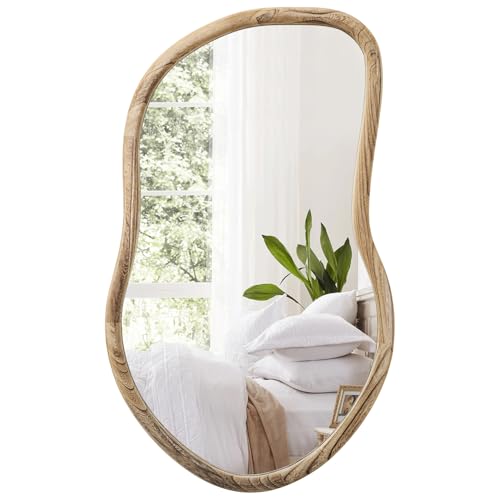
Helpful pick
FEUFOAM Irregular Wall Mirror Wood Asymmetrical Mirror Large Bathroom Vanity Mirrors Natural Wood Framed Abstract Mirrors for Wall Living Room Bedroom Decorative
With a natural wood frame, this irregular mirror adds warmth without the visual bulk often found in heavy, dark-framed bathroom mirrors.
Examples for Common Small-Bathroom Layouts
A common small-bathroom setup has a 24 to 30 inch vanity beneath a single wall light. A horizontal rectangle often works best because it widens the sink zone without forcing a tall mirror into the light fixture’s space. Keep it centered over the vanity and use a clean frame so the mirror and vanity read as one unit.
If the bathroom feels like a hallway, with the vanity on a long narrow wall and little side clearance, a horizontal rectangle can reinforce the room’s width without requiring extra side space. Check that it does not run into a towel bar or the top of a nearby cabinet.
Round or oval mirrors often work best in tight corner installations. If a rectangle would hit a door swing or leave an awkward gap beside a tile transition, a curved edge can bridge the space more naturally. An oval is useful when you want the softness of a round mirror with more width above a compact vanity.
In a bathroom covered in straight, grid-like tile, replacing a square or rectangular mirror with an oval can reduce visual harshness. The curved edge interrupts the tile pattern and makes the room feel less busy without changing the tile.
If the vanity is wider than the wall can comfortably support, choose a slightly smaller mirror and center it carefully. A simple frame keeps the arrangement tidy. An oversized mirror can press against nearby fixtures and make the room feel more crowded.

Helpful pick
TRAHOME 32” x 18” Irregular Asymmetrical Wall Mirror
This asymmetrical wall mirror is sized perfectly for standard vanities, providing a stylish, modern focal point that maximizes your limited space.
FAQ
What is the best mirror shape for a small bathroom?
A horizontal rectangle is usually the best default when you want the room to feel wider. Choose a vertical rectangle if the bathroom feels short or the ceiling seems low. Round and oval mirrors work well when you want a softer, less boxy look or need to fit around tight corners and straight tile lines.
Should my mirror be the same width as my vanity?
The mirror should feel balanced with the vanity. If it is much narrower, the vanity can look oversized for the room. If it is much wider, it may crowd doors, storage, or other fixtures. Center the mirror over the sink area, then choose a width that relates comfortably to the vanity and surrounding wall.
What mirror size is too big for a small bathroom?
A mirror is too big when it overwhelms the wall or creates awkward clearance around lights, doors, towel bars, or cabinets. If its edges land close to surrounding interruptions, the layout will feel cramped. Tape the proposed rectangle or circle to the wall and view it from the doorway before ordering.
Are round mirrors good for small bathrooms?
Yes. Round mirrors soften hard edges and fit well in tight spaces. They are especially useful when the bathroom has straight tile lines or when a rectangular mirror would sit awkwardly beside a door or cabinet. For a vanity, an oval can offer the same softness while spanning the wall more effectively.
What is the most common mistake when choosing a mirror shape for a small bathroom?
The most common mistake is choosing a shape that fights the layout. A square mirror may look too narrow in a bathroom that needs more width, while a tall mirror may conflict with a low ceiling or light fixture. Ignoring clearance around towel bars, doors, and storage creates the same problem.
Measure the vanity, wall, lights, and door swing before you buy.