

Getting the mirror height wrong is the easiest way to make your bathroom feel “off” – and you may notice it within 10 seconds. The best default is to mount the mirror with its center near eye level, usually 57 to 65 inches from the finished floor, depending on your height and how you stand at the sink.
For most bathrooms, I would start with an eye-level center mount, test it with painter’s tape, and adjust it by 1 to 2 inches if your face is not framed naturally. Shared bathrooms, tall mirrors, unusual backsplashes, and vanity lighting may justify a different position.
Featured Snippet:
The best height for a vanity mirror is eye level, with the mirror’s center typically 57 to 65 inches from the floor. If the mirror is wide, shallow, or shared by adults and kids, use the average eye height and adjust the top and bottom so faces sit naturally in the frame. When in doubt, mock up the position with painter’s tape, then verify it while standing normally at the sink.
Best Vanity Mirror Heights at a Glance
- Best overall: Eye-level center, with the mirror center around 57 to 65 inches from the floor
- Best for a single user: Center the mirror on that person’s normal standing eye height
- Best for a shared bathroom: Use the average comfortable eye height of the daily users
- Best for an oversized mirror: Prioritize face framing over a perfect top-edge position
- Best for a lighting upgrade: Align the mirror and bulbs to avoid under-eye shadows
- Best for an uncertain remodel: Use a positionable mounting method and test with painter’s tape
- Most important measurement: Measure from the finished floor, not the countertop
The Best Height for a Vanity Mirror
The best vanity mirror height centers your face naturally when you stand at the sink in your normal posture. In many US bathrooms, that puts the mirror’s center between 57 and 65 inches from the finished floor.
That range is a starting point, not a rigid installation rule. Your height, sink position, vanity design, mirror size, and lighting all affect the final location. A taller mirror may extend farther above your head, while a short mirror may crop your forehead or chin even when its center is correctly positioned.
Measure from the finished floor rather than the countertop. Countertop heights vary by vanity and installation, and backsplashes can add several inches to the wall. A floor-based centerline remains consistent across different bathroom layouts.
Lighting also affects the result. Vertical bulbs or a light bar can create shadows under the eyes or chin when the mirror sits too high or too low. A single overhead fixture may reflect harshly or leave your face looking washed out. The best mirror height is the one that frames your face comfortably and works with the lights switched on.
How to Choose the Right Mounting Height
Stand where you actually use the sink, with your feet in their normal position, your shoulders relaxed, and your head facing forward. Measure from the finished floor to your eyes. If several people use the vanity, measure each person and choose a compromise based on who uses it most often.
Next, check how the mirror itself frames your face. A mirror’s center can be at the right height while the glass still cuts off your forehead or chin. The mirror’s height and width matter just as much as its centerline.
Before drilling, tape a rectangle on the wall that matches the mirror’s actual height and width. If that is inconvenient, tape a horizontal line showing the proposed center. Stand at the sink and look straight ahead. Move the tape up or down 1 to 2 inches until your face sits comfortably in the frame.
Check the surrounding clearances as well. A backsplash, wall cabinet, trim, mounting bracket, or thick mirror housing can reduce the space available. Include the frame depth and back panel in your tape test, especially if the mirror hides wiring or has built-in hardware.
Ranked Vanity Mirror Height Options
| Rank | Option | Key Spec/Measurement | Best For | Tradeoffs |
|---|---|---|---|---|
| 1 | Eye-level center for the primary user | Mirror center at 57 to 65 in from the floor | Master baths and single-height households | Less ideal when kids use the sink often |
| 2 | Eye-level center for a shared bathroom | Center at the average comfortable eye height | Family bathrooms | No single user gets a perfect position |
| 3 | Tall mirror with face-focused framing | Keep the face centered even if the top edge sits high | Oversized statement mirrors | A short tall mirror can crop the hairline |
| 4 | Light-aligned placement | Position the mirror so bulbs avoid under-eye shadows | Vanity lighting upgrades | Requires testing with the lights on |
| 5 | Adjustable or positionable mounting | Use hardware that allows small height changes | Rentals and uncertain remodels | Takes more planning at installation |
| 6 | Placement around an unusual backsplash | Account for backsplash height and tile lines | Curved walls and unusual tile layouts | Greater risk of a visual mismatch |
1. Eye-Level Center for the Primary User
This is the strongest default for a bathroom used mainly by one person or by people of similar height. Set the mirror center near the primary user’s standing eye level, usually somewhere within the 57 to 65 inch range.
This approach gives the clearest reflection without requiring you to tilt your head. It also keeps the installation simple because you can focus on one person’s normal posture rather than forcing a compromise.
The tradeoff is obvious: a child or much shorter adult may need to stretch, stand on tiptoe, or use a separate mirror. For a master bath, that is usually a reasonable compromise.
2. Average Eye Height for a Shared Bathroom
A shared bathroom needs a livable compromise rather than a perfect position for the tallest person. Measure each daily user while standing at the sink, then place the mirror center closer to the average comfortable eye height.
This works best when the mirror is wide enough to give everyone a natural view. A mirror that is too narrow can make a compromise height feel worse because users must also shift sideways or lean toward the glass.
If kids use the vanity most mornings, their needs should carry more weight than occasional use by taller adults. If the compromise still feels uncomfortable, consider a secondary handheld mirror or a different mirror size for that vanity.
3. Tall Mirror Optimized for Face Framing
A tall mirror gives you more visual coverage, but its top edge may sit higher than expected. Keep the user’s face centered first, then check whether the mirror overwhelms the wall or interferes with lights, cabinets, and trim.
A tall mirror can look impressive while still functioning poorly if its lower edge cuts off the chin or its upper edge leaves too much unused space. Adjust the center slightly downward when necessary so the face remains naturally framed within the larger glass.
This option suits oversized mirrors and statement installations, but it needs a careful tape mock-up. The larger the mirror, the more noticeable a small placement error becomes.
4. Light-Aligned Placement
Lighting can justify a small adjustment from the standard eye-level target. Side-mounted bulbs and light bars should illuminate the face evenly rather than cast shadows under the eyes or chin.
After choosing a centerline, turn on the vanity lights and stand in your normal position. If the light creates a shadow band, move the mirror slightly or adjust the bulb placement instead of assuming the original measurement is automatically correct.
This approach is especially useful in bathrooms with limited natural light or a single overhead fixture. The tradeoff is that the ideal mirror position may depend on the exact light fixture, so test after dark as well as during the day.
5. Adjustable or Positionable Mounting
Positionable hardware makes sense when the users, lighting, or final wall layout are uncertain. It gives you room to make small height changes without committing immediately to one exact location.
This is a practical choice for rentals, remodels, and installations where the backsplash or vanity may still change. It also helps in a shared bathroom where you want to test the compromise before making the mounting permanent.
The downside is extra planning. The mounting system must support the mirror securely while still allowing the adjustment you need. A temporary tape test is still worthwhile before installation.
6. Placement Around an Unusual Backsplash
Curved walls, tall backsplashes, unusual tile lines, and decorative trim can override a simple centerline rule. The mirror should still frame the face naturally, but it also needs to sit cleanly within the wall’s visual boundaries.
Measure from the finished floor first, then check the mirror’s top and bottom against the backsplash and surrounding features. A technically correct height can look misplaced if it cuts across a tile detail or leaves an awkward gap above the sink.
This option carries the highest risk of visual mismatch. Mock up the full mirror shape with painter’s tape before drilling, not just its centerline.

Helpful pick
MOMOKUBA Makeup Mirror with Lights, 20X Magnifying Mirrors, Height Adjustable, Vanity Mirror with Lights Rechargeable 3 Color Modes, Double-Sided Detachable Travel Mirrors, Gift for Women, White
This height-adjustable, double-sided magnifying mirror is an excellent choice for shared bathrooms where different users need customized viewing heights and angles.
Practical Measurement Tips Before You Drill
Start by standing at the sink in your normal stance. Do not measure while leaning forward, looking up at the wall, or standing several feet away. Keep your feet where they will normally be, relax your shoulders, and look straight ahead.
Tape the mirror outline to the wall. Match the actual mirror height and width, including the frame if it has one. Look at your reflection from the position where you brush your teeth, wash your face, or apply makeup. Move the outline 1 to 2 inches if your forehead, chin, or hairline feels awkwardly cropped.
Check the top and bottom edges against nearby fixtures. Include the backsplash, cabinet, trim, brackets, wiring, and mirror housing. A framed mirror or backlit model may sit farther from the wall than a flat sheet of glass, which can change reflections and interfere with the light beam.
💡 Accurate measurements are essential for any home project; this drill bit gauge helps you maintain precision when installing your new mirror hardware. 2 Pieces Drill Bit Size Gauge Drill Bit Guide Stainless Steel Drill Gauge 29 Holes Metal Drill Size Gauge Tool for 1/16 Inch to 1/2 Inch Size Bits Measurement (Black).
Why the Correct Height Makes a Difference
A mirror centered near eye level is easier to use because you do not need to tilt your head up or down to see your face. That makes daily grooming more comfortable and eliminates the small but persistent annoyance of standing at the wrong angle.
Correct placement can also improve the lighting. When the mirror sits at a workable height relative to the bulbs, light reflects toward your face instead of bouncing toward the ceiling or creating shadows around your eyes and chin. This matters most in bathrooms with limited daylight or one overhead fixture.
Families gain a practical safety benefit as well. A mirror that is too high encourages children to stand on their toes or use the counter for balance. A compromise height makes the vanity easier for the most frequent users, even if it is not perfect for everyone.
Common Vanity Mirror Height Mistakes
The most common mistake is measuring from the top edge rather than the mirror’s center. Top-edge rules stop working when you change the mirror’s height, frame, or shape. A centerline based on actual eye level gives you a more reliable starting point.
Skipping the tape test causes many avoidable installation problems. A mirror can be positioned correctly according to a tape measure and still crop your forehead, cut off your chin, or clash with the lights. Five minutes with painter’s tape can prevent re-drilling and patching the wall.
Finally, do not ignore the mirror’s depth. A thick frame or back panel can alter reflections and block part of a nearby light beam. Include the finished mirror depth in your test, particularly when the mirror sits close to wall fixtures.
Vanity Mirror Height
Suppose the mirror is 24 inches tall and its center is set at 61 inches. The top edge will sit around 73 inches, and the bottom edge around 49 inches because half the mirror height is 12 inches. That calculation helps when the wall includes a light bar, tile detail, or electrical outlet. Choose the center height first, then check those edges against the actual wall.
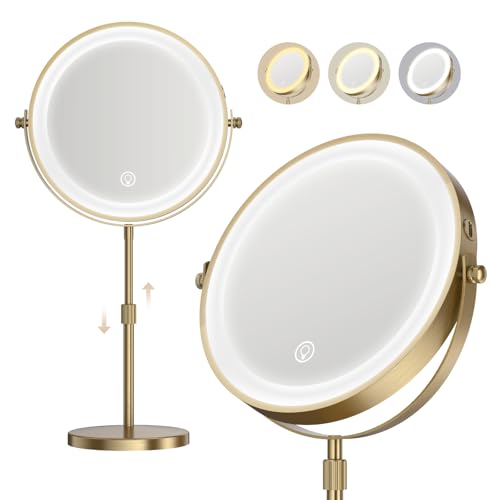
Helpful pick
Dienmern Lighted Makeup Mirror, 1X/30X Double-Sided Magnifying Vanity Mirror with Lights, 360° Rotation, 5000mAh Rechargeable Adjustable Brightness with 3 Colors for Dorm, Living Room, Women Gift
When calculating your mirror’s placement, this rechargeable, height-adjustable vanity mirror provides a flexible solution that fits perfectly into your measured wall space.
Final Recommendation
The best measurement on paper is only a starting point. The right height is the one that keeps your face centered, leaves sensible clearance around the vanity, and works with the lights when you actually use the room.

Helpful pick
FENNIO Vanity Mirror with Lights 13” x 17” Makeup Mirror with Lights,Vanity Mirror Touch Screen with 3-Color Lighting,Dimmable,for Vanity Desk Bedroom White
For your final setup, this touch-screen vanity mirror provides adjustable lighting and a versatile design to ensure your grooming area is perfectly illuminated.
FAQ
What is the best height for a vanity mirror if I only have one number to follow?
Use eye level. A practical target is to place the mirror center about 57 to 65 inches from the floor. If you are unsure, begin near the middle of that range, stand normally at the sink, and adjust until your face is centered.
Should I measure from the countertop or the floor?
Measure from the finished floor. Countertops vary by vanity type and installation, and backsplash heights differ as well.
How do I choose the height for a shared bathroom with kids?
Choose a compromise based on who uses the mirror most often. Measure each user’s eye height while standing at the sink, then place the mirror center near the average comfortable height rather than automatically using the tallest person’s eye level. If that compromise feels poor for one group, use a different mirror size or add a secondary mirror.
Will vanity lighting change the ideal mirror height?
Yes. Side-mounted lights and light bars can create under-eye shadows when the mirror sits slightly too high or too low. After choosing a centerline, switch on the lights and check your reflection from your normal position. Move the mirror slightly or adjust the bulbs if the lighting is uneven.
What is the most common mistake people make when mounting a mirror?
People often measure from the top edge instead of the mirror’s center, or they skip the tape test. That can produce a mirror that meets a planned measurement but crops the face awkwardly. Painter’s tape lets you test the position for 5 minutes before drilling.